
< Stromberg Bulletins View all
WILL THE NEW 97 FIT MY CAR?
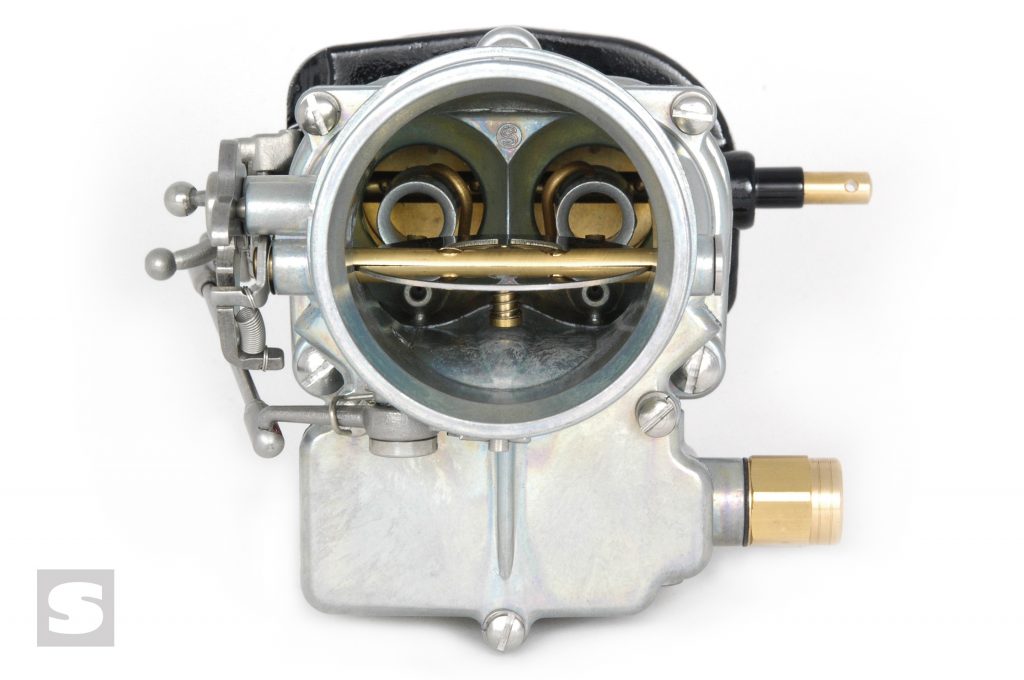
The new genuine Stromberg 97 fits wherever an old Stromberg 97 does. And pretty much any other Stromberg EE-1 model for that matter, eg. The Stromberg model 40, 48, 81, LZ, and all of the old three-bolt Ford and Holley 94-derivative carburetors from the same period (from 1932 to round 1953). So let’s take a look at the usual applications, and everything else you might need to know for alternative uses – manifold stud pattern/spacing/air cleaners/hood clearance/throttle and choke linkage/fuel lines/distributor vacuum and flow in cfm.
Stock, hot rod and alternative applications
The Stromberg 97 has been around a long time, so let’s cover the traditional applications first. The 97 was standard on Ford V8 passenger car and truck engines from around 1935 to 1938. They were also offered as an aftermarket replacement for Ford V8 from 1932 right up to 1953, though the ‘49-53 applications used a slightly different model (for distributor vacuum, which we’ll come to later). The 97 will also work as a replacement for the smaller Stromberg 81, which was standard on the small Ford V8-60 engine from 1937-40, though we do offer a ‘new’ Stromberg 81 model too.
Then there’s the hot rod applications. As the 97 became the hot rod carburetor of choice, so all the early multi-carb intakes were set up for 97s right through until the muscle car era. Hot rod multi-carb intakes for 97s are still available new for Ford flathead V8s, early Ford 4-cyl engines (Model A,B,C), early Chevy straight 6, Chevy small block V8 and early Cadillac V8. And intakes for other vintage overhead valve engines can still be found at swap meets.
Alternative applications
We are often asked about conversions – making new intake manifolds or adapter plates to fit 97s on new engine applications. The 97 is a very simple carburetor which makes it ideal for adapting, so let’s look at what you need to bear in mind:
Manifold stud pattern and spacing, air cleaners and hood clearance
Our 97 carburetor has a three bolt intake mount – as used on Ford V8 from 1933 right up to 1953. If you’re making an adapter plate, the key dimensions are:
Bore centers are 1.34in apart. The two bores are 1-3/16in diameter. The two front fixing bolts are 3.12in apart and 0.88in from the carb centre (throttle) line. And the third rear bolt is centered on the front two, but 1.88in back. Aftermarket intakes tend to vary but if you are making an adapter plate and you set the carbs 4.75 inches apart you’ll match the Offenhauser standard and you’ll get a Stromberg TwoStep linkage to fit too.
The OD of the casting at the top where the air cleaner fits is 2-5/8th inch and the overall height of the 97 is 5-5/8 inch plus the intake gasket, though the air cleaners/scoops sit 5/8 inch down over the top of the carb mouth.
Throttle and choke
The 97 throttle and choke levers were designed to work with solid rods to the pedal and dashboard and have a 0.275 inch OD ball end fitting. Aftermarket 97 models designed originally to fit the 49-53 Fords had a different choke lever for a cable choke (with a bracket to hold the cable outer sleeve) and we offer this conversion both as a kit (9552K-C) or a complete carburetor with the cable choke parts installed (9510A-C).
Something else. The standard 97 throttle lever is designed to be pulled from the pedal linkage at the firewall end. If your throttle pedal pushes (like the 1949-51 Mercury and some LZ models) you need our 9581K-LZ kit or 9510A-LZ carb with it installed.
The fuel inlet is usually the easiest part of any conversion. We offer brass hose end fittings (9080K) and stainless steel banjo fittings with one or two outlets (9082K and 9083k). If you want to build hard lines, we offer ‘Ford Nut’ compression fittings (9081K) to install 1/4inch hard lines into the S-jet inlet fitting. The thread into the 97 inlet is 1/2in by 20 teeth per inch.
Distributor vacuum
As a rule, all aftermarket distributors use what we call ‘ported vacuum’ to advance the engine in the cruise rpm range. There is no ported vacuum take-off on the regular Genuine Stromberg 97 carb, so if your distributor can use ported vacuum (and please check the spec) you will need our 9510A-VP (vacuum port) option. All Stromberg BIG97 Primary carbs have this port as standard. There’s a separate Tech article, “Stromberg 97 and Vacuum Advance. Your Questions Answered” on this Tech Center.
We do not recommend drilling the 97 base casting to install a vacuum take-off. A few rare old-school Stromberg 97 models (called the ‘1-1’) did have a vacuum port built into the base, but this was specifically for the ’49-53 Ford Loadomatic distributor which had no base-level mechanical advance built in. So the carb provides vacuum from at three different points through the special base and bowl castings.
In case you’re wondering, the early Ford 32-48 crab-type distributors use a vacuum brake, not advance, which takes vacuum off the intake manifold. Completely different deal.
Flow in cfm
Whatever conversion you are planning, you need to ensure you have enough flow through the carburetor to feed the engine at maximum rpm. There is plenty of information on the internet about working out your requirements based on cubic capacity, maximum RPM and volumetric efficiency, so let’s just say that the Genuine Stromberg 97 has been independently measured at 162cfm per carburetor measured at the 1.5inch Hg pressure drop measure that is usually quoted for 4bbl carbs. Traditionally, 2bbl carbs were measured at 3inch Hg pressure drop, but in reality carbs on modern engines never see that much vacuum at full throttle. The 3inch measure comes out higher so sounds good, but we believe it’s misleading.
Just remember, as a rule an engine will run with a big carburetor, but a small carb on a big engine will run out of rpm when it can’t pass enough of air through the carburetor to feed the cylinders.
